India’s Gut Health Obsession!! How digestion is becoming a new consumer category
This story does not start with kombucha, probiotics, or fibre gummies. It starts with a quiet but persistent question urban Indians are now asking themselves every single day.
Why do I feel bloated, tired, inflamed, gassy, foggy, heavy, acidic, constipated, anxious even when I eat ‘right’?
This is the real behavioural shift.
For a large cohort of urban Indians, internal discomfort has become the default state. Not illness. Not disease. Just a constant feeling that the body is slightly off.
The drivers are structural, not personal failure:
- Ultra-processed diets mixed with irregular eating hours
- Long sedentary workdays with compressed movement
- Chronic, low-grade stress rather than acute burnout
- Repeated antibiotic exposure over the years
- Sleep deprivation normalised as ambition
None of these show up immediately in blood reports. None trigger a doctor visit. But together, they create a state of persistent internal friction.
Gut health becomes powerful because it is the first explanation that connects the dots: energy, mood, digestion, immunity, skin, anxiety, sleep.
This is how gut health stops being wellness and becomes a daily functional need-state.
#1 Why this is a new category, not a repackaging of Ayurveda?
India has always been digestion-first. That is not new. What is new is the framing, the format, and the frequency.
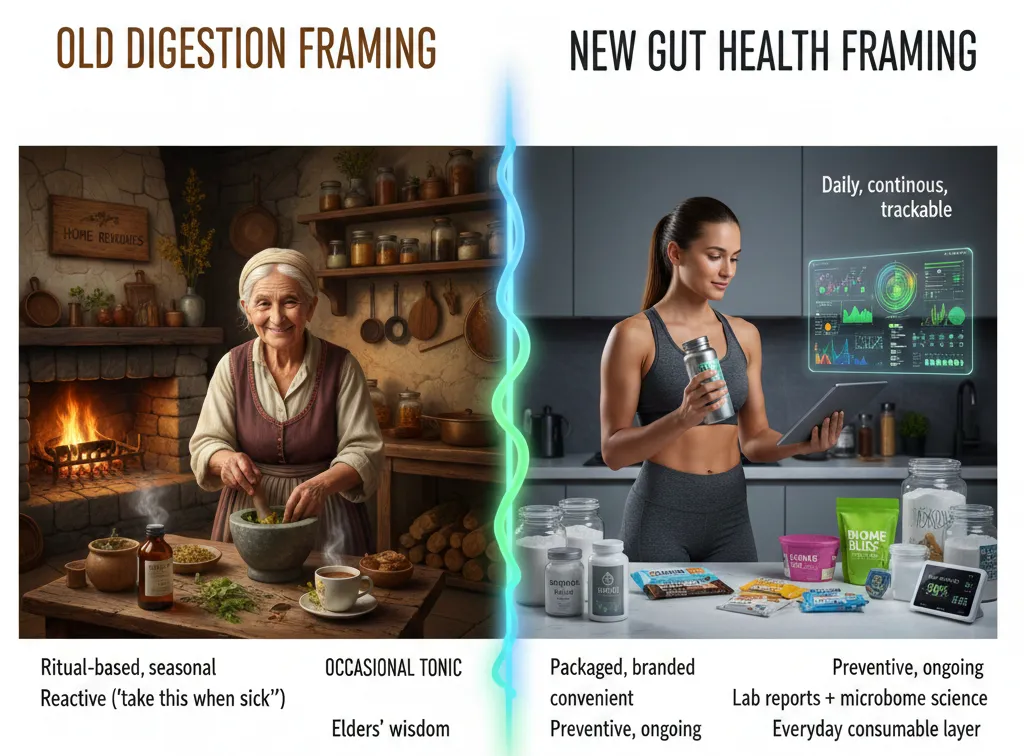
This is modernisation + productisation of digestion.
Ayurveda spoke about digestion as philosophy. Gut health speaks about it as infrastructure and infrastructure demands consistency, compliance, and convenience.
#2 The behavioural stack forming around the gut
Gut health is not emerging as a single purchase. It is emerging as a stacked daily behaviour. A typical urban routine is quietly taking shape:

This matters because this behaviour repeats daily, multiple consumption moments exist and products reinforce each other instead of substituting
For founders, this is not one SKU.
This is an ecosystem waiting to be built.
#3 Why kombucha bars and fermented cafés are appearing now?
They serve three far more important roles:
- Social proof: Fermentation moves from medicine to lifestyle when people are seen consuming it casually, socially, publicly.
- Trial environments: Fermented flavours are unfamiliar. Cafés reduce friction by letting people experiment without committing to a pack.
- Legitimisation: When something is served in a café, it stops being treatment and starts being normal.
They play the same historical role that cold-pressed juice bars played for detox and protein cafés played for fitness. They signal mainstreaming, not niche.
#4 The identity shift: from healthy eater to gut-conscious person
This is subtle but foundational. People are no longer defining themselves by what they eat. They are defining themselves by how their body reacts. You now hear statements like:
- “I have a sensitive gut”
- “I can’t handle gluten/dairy/raw food”
- “I’m working on my microbiome”
This is the birth of a new identity cohort. Once identity forms:
- People forgive price premiums
- Habits compound instead of reset
- Switching costs rise emotionally, not just financially
This is how categories get durable.
The categories that will emerge (not just products):
The opportunity here is not “launch a probiotic”. It is to build new shelves. Likely category creation includes:
- Daily gut waters (fibre + minerals, not flavoured water)
- Low-FODMAP ready meals for urban professionals
- Fermented side-dish brands that sit next to meals
- Digestive snack formats (neither protein nor keto; gut-first)
- Children’s gut foods (immunity framed through digestion)
- Office gut reset kits for weekday damage control
- Gut diagnostics paired with subscription nutrition loops
This ensures the gut is not an add-on. It becomes a default layer across food, beverage, and supplements.
#5 Why this will be sticky?
Most lifestyle fads spike on novelty. Gut health compounds on relief. The underlying problem is structural, not cyclical; modern diets, work patterns, stress, and sleep are not reverting anytime soon. The payoff is also immediate and felt, not abstract: people experience lighter digestion, better energy, improved mood, and regularity within days, not months.
The behaviour itself is daily rather than episodic, embedded into routines through water, snacks, meals, and supplements instead of occasional detoxes. At the same time, the scientific narrative around the microbiome, inflammation, and the gut–brain axis keeps strengthening, giving consumers continuous validation. Once digestion starts to feel normal or good, people actively resist going back to discomfort. That resistance creates behavioural lock-in, arguably the strongest moat any lifestyle category can have.
In all, Gut health is not emerging as another wellness obsession. It is becoming a foundational layer of modern living in India (quietly, consistently, and irreversibly). Like protein reshaped fitness, sunscreen reshaped skincare, and UPI reshaped payments, gut health will reset everyday behaviour rather than introduce a new product.
The winners in this space will not be those chasing trends, but those building for a long-term behavioural shift that people come to rely on every single day.
Note: This is part 2 of a long-form series decoding India’s next lifestyle behaviours before they become categories. Every decade, Indian consumption quietly changes direction long before the market notices. New behaviours appear first as personal choices, then as communities, then as habits, and only much later as billion-rupee categories.
By the time a category has a name, most of its upside is already gone.
This series is an attempt to map what is forming right now, the shifts in how urban India wants to live, spend, learn, travel, eat, and recover and to identify the consumer layers that will define the next generation of enduring lifestyle brands.